The Art and Science of Light Diffusion: How Your Lamp Transforms a Room
Most people choose a lamp for how it looks. The designers who changed interior lighting chose it for how it scatters light. Here is what diffusion actually does — and why 3D printing made it the most exciting frontier in lamp design.
What Makes One Lamp Feel Warm and Another Feel Clinical?
Walk into two different rooms. In one, a bare bulb hangs from the ceiling — bright, functional, slightly uncomfortable to look at. In the other, a sculptural lamp sits on a side table, its light spilling through an intricate lattice of fins or curves, casting rippling shadows across the wall while the room feels instantly softer, richer, more alive.
The difference is light diffusion — and it is the single most important quality in a lamp that most people never think about.
What Is Light Diffusion?
Light diffusion is the process by which a single point of light (a bulb) is scattered, spread, and softened as it passes through or around a material. An undiffused bulb emits light in one concentrated direction. A diffused lamp spreads that same light across a wider area, softening shadows, reducing glare, and filling a space with warmth rather than harshness.
The word comes from the Latin diffundere — to pour out in different directions. And that is exactly what a well-designed lamp shade does: it takes light that wants to travel in a straight line and coaxes it to pour outward, inward, sideways, and through, creating the sensation that a room is glowing rather than merely lit.
At its most basic, diffusion requires two things: a light source and a material or structure that intercepts it. The properties of that material — its thickness, its texture, its geometry, the gaps and density of its surface — determine the quality, warmth, and character of the light that emerges.
The Physics: Why Geometry Determines Light Quality
Most people think of lamp shades as decorative. But every groove, every rib, every fin, every pore in a lamp's surface is making an optical decision.
When light hits a flat, opaque surface, it bounces back. When light hits a translucent material, some passes through, some bounces, and some is absorbed — the ratio of each depends on the material's translucency. When light hits a textured surface with ridges or fins, each ridge acts as a small redirector, scattering the emerging beam at a slightly different angle than its neighbours. The cumulative effect of dozens or hundreds of these micro-redirections is the diffuse, layered, sculpted light that makes a beautifully designed lamp so different from a bare bulb.
The spacing matters too. Tightly spaced fins filter more light, creating moody pools. Wider geometry with larger gaps creates brighter ambient fills. Curved surfaces wrap the light around themselves, softening the transition between lit and shadowed areas.
This is why the surface geometry of a lamp is not merely aesthetic — it is the instrument through which the lamp plays its light.
Why 3D Printing Changed Everything for Lamp Design
Traditional lamp shades were limited by manufacturing constraints. A shade had to be made from flat material — paper, fabric, metal — then bent or stitched into shape. The geometry of light diffusion was therefore always relatively simple: a cone, a cylinder, a sphere.
3D printing removes those constraints entirely.
With additive manufacturing, a lamp designer can create structures that are impossible to produce any other way: nested helixes, interconnected lattices, tapered fins that shift angle as they rise, honeycombed meshes that vary in cell size across the surface. Each of these structures creates a qualitatively different diffusion pattern — and a qualitatively different experience of light in a room.
This is the founding principle behind every Lorenova lamp. Each design begins not with "what should this lamp look like?" but with "what quality of light should this lamp produce?" The form follows the physics.
Five Diffusion Patterns — and What Each Does to a Room
1. The Parallel Rib: Structured Warmth
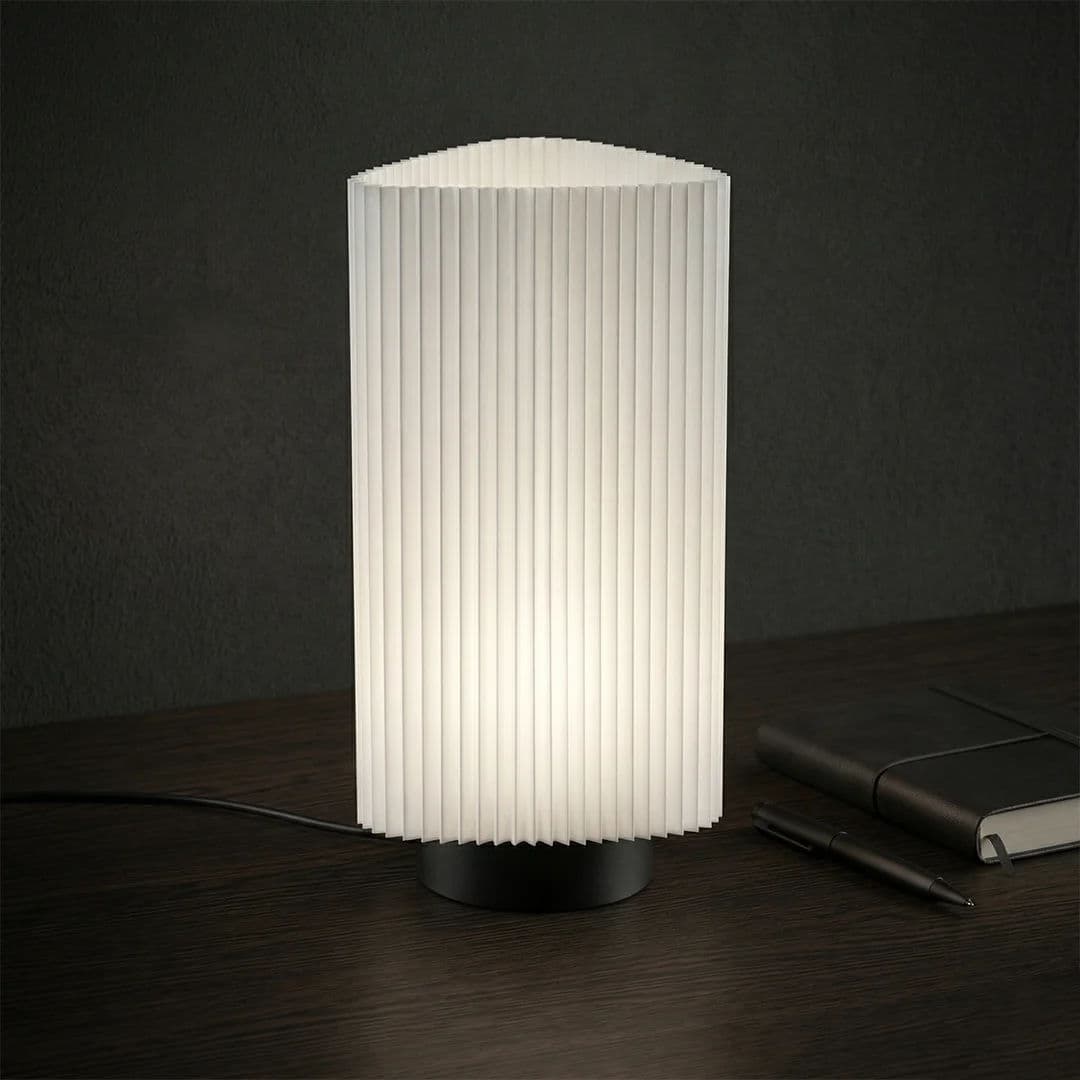
A lamp with closely-spaced vertical fins creates multiple parallel channels for light to escape. As light emerges through each channel, it fans outward slightly, producing a series of overlapping cones of warm light. The visual effect is simultaneously structured and soft — disciplined lines of light with gentle penumbras between them.
This pattern is ideal for a reading corner or bedside table where you want warmth and intimacy without flooding the space.
Lamella Table Lamp — ₹4,999 · Forty vertical fins in a triangular prism form. Each fin creates its own channel of filtered light, producing a warm, geometric glow that defines the space around it. Hand-finished in Warm Ivory, Pure White or Slate Grey. Shop Now →
2. The Spiral: Dynamic, Directional Light
When fins or grooves follow a spiral path around a form, the light they release rotates optically as you move around the lamp. Standing to one side, you see the interior illuminated through the open angle of the spiral. At another angle, the same lamp appears more closed, more contemplative.
Spiral-diffusion lamps reward you for moving around them. This makes them ideal as centrepieces in living rooms or dining spaces where they are seen from multiple angles throughout the day.
Voluta Table Lamp — ₹2,899 · A spherical form wound with continuous spiral grooves. The warm-white LED within casts a slow rotation of light and shadow that shifts with your vantage point. Designed for 360° viewing. Shop Now →
3. The Wave: Organic Ambient Fill
Undulating, wave-like ribs scatter light more irregularly than straight fins. Rather than producing defined beams, wavy geometry creates a field of diffuse light — a gentle, room-filling glow with no harsh edges and no obvious source. The effect is deeply organic, reminiscent of light filtering through rippled water or desert sand dunes at dusk.
Wave-pattern lamps are excellent for living rooms where you want a lamp that enriches the entire room rather than spotlighting a single area. They are also forgiving of imperfect placement.
Ondula Table Lamp — ₹2,599 · A stacked column of undulating rib-forms. The organic wave pattern produces a continuous ambient fill that softens an entire room. Premium PETG, matte finish, warm-white LED included. Shop Now →
4. The Diagonal Twist: Shadow as Sculpture
When ribs are set at an angle — neither vertical nor horizontal but diagonal across the lamp's surface — the shadows they cast rotate and elongate on surrounding walls. As evening deepens, the shadows lengthen. The lamp becomes not just a light source but a shadow projector, filling your walls with quiet, shifting geometry.
Wall-mounted versions of this effect are especially powerful in narrow corridors or accent walls, where projected shadows travel across the wall surface at full scale and turn architecture into art.
Torsa Wall Sconce — ₹1,499 · Diagonal twisted ribs on a compact wall-mounted form. Projects its ribbed shadow pattern dramatically across the wall behind it. The most affordable way to introduce diffusion design into an Indian home. Shop Now →
5. The Mesh: Dappled, Celestial Light
A lamp enclosed in a fine mesh — particularly a hexagonal or honeycomb mesh — breaks light into hundreds of tiny beams, each emerging from its own small cell. The result is a dappled, almost celestial quality: like sunlight through a fine screen, or the stippled light of a forest canopy. Hung overhead, this effect becomes dramatic as the ceiling receives a warm constellation of points.
Pendant lamps are the natural application of mesh diffusion, allowing the effect to rain down into the room from above — transforming a dining table or entryway into something genuinely extraordinary.
Favus Pendant Light — ₹6,999 · A gourd-shaped pendant enclosed in hexagonal mesh. Hung above a dining table or in a double-height entryway, it casts a warm honeycomb pattern across ceiling and walls. Includes warm-white LED and ceiling canopy. Shop Now →
How to Choose the Right Diffusion Pattern for Your Space
The right lamp for a space depends on three questions:
How large is the space? Larger rooms benefit from lamps with wider-gap geometry — mesh and wave patterns — that throw light further and fill a volume. Smaller rooms are better served by tighter patterns (fins, ribs) that create localised warmth without flooding the space.
Where will the lamp sit? A bedside lamp should diffuse softly in a concentrated direction — parallel fin designs work well. A centrepiece lamp in a living room should be interesting from every angle — spiral and wave designs reward 360-degree viewing. A pendant above a dining table should send light downward while casting pattern upward — mesh pendants excel here.
What mood are you seeking? Tight, geometric diffusion (fins, ribs) creates a structured, considered atmosphere — suited to studies and reading nooks. Organic diffusion (waves, mesh) creates a relaxed, ambient mood — better for living rooms and bedrooms.
The good news is that Indian homes tend naturally toward layered, multi-source lighting. Two or three lamps with different diffusion patterns, placed thoughtfully through a space, create a composition that is far richer than any single source could achieve.
A Note on Material: PLA vs PETG
The diffusion quality of a 3D-printed lamp depends not only on geometry but on the material it is printed from. PLA (polylactic acid) has a slight natural warmth to its translucency — light passing through thin PLA walls takes on a faintly golden cast that deepens the feeling of warmth. PETG (glycol-modified PET) is slightly cooler and more neutral, closer to frosted glass in character.
Both materials diffuse a warm-white LED beautifully. The choice is subtle but real: PLA for rooms where you want the lamp to feel organic and intimate; PETG for spaces with a more contemporary, architectural palette.
All Lorenova lamps include a warm-white LED bulb specifically selected for its interaction with the lamp's material and geometry. There is no guesswork.
The Craft Behind Every Light
Every Lorenova lamp is designed to answer a single question: what is the most beautiful quality of light this geometry can produce?
That question is asked at the design stage, refined in prototyping, and answered in the hand-finishing that each lamp receives before it leaves our studio. The geometry you see when you look at a Lorenova piece is not decoration — it is the mechanism through which light becomes warmth, ambience, and presence in your home.
If you have been searching for a lamp that does more than illuminate — one that genuinely transforms the quality of light in a room — the answer lies in diffusion design.
Free delivery across India on all orders above ₹999. Every piece is handcrafted and made to order in India.
Explore the Collection
Discover Lorenova's handcrafted lighting
Every piece is individually crafted and hand-finished in India. Free shipping on orders above ₹999.
Shop Now