How to Choose a Table Lamp: The Complete Guide for Indian Homes
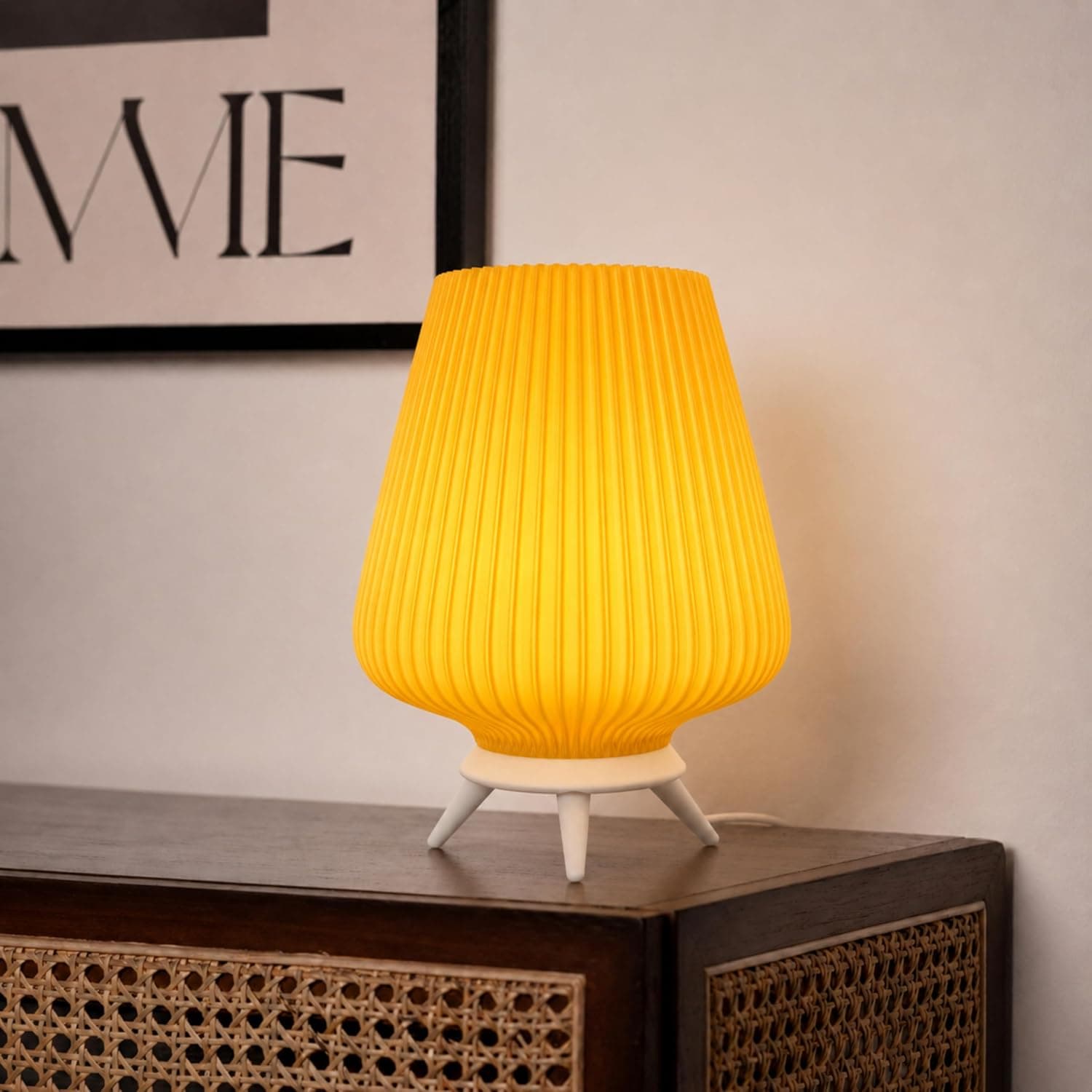
A table lamp is the light you actually reach for every evening — and the one most people buy backwards. Here is how to choose height, shade shape, footprint and colour temperature for an Indian home.
The Light That Actually Gets Used
A ceiling light is chosen once and forgotten. A table lamp is the light you reach for — switched on at seven, left burning until midnight, the fixture that decides whether a room reads as a waiting area or as somebody's home. Which is why buying a table lamp in India deserves more thought than it usually gets — how to choose a table lamp has real answers, not just preferences.
Most people buy backwards. They fall for a shape, bring it home, set it on the nearest free surface and hope. The lamp is then too tall, too bright, or pointed at nobody. The better order is the opposite: decide what the light has to do, settle the height, then choose the form that delivers it. Get that sequence right and a ₹1,399 lamp will outperform an expensive one placed carelessly.
What a Table Lamp Is Actually For
A table lamp does one of three jobs, and the honest ones commit to a single answer.
Task light puts usable brightness on a small, defined area — a book, a keyboard, a notepad. It wants a shade closed at the top and open at the bottom, pushing light down onto the surface rather than into your eyes.
Ambient light fills the room with a soft, sourceless glow. You want a shade that glows all over, light escaping between the ribs so the lamp reads as a warm object rather than a beam.
Accent light exists to be looked at. The shadow it throws on the wall behind is the product — ribbed, twisted and fluted forms belong here.
Almost every mistake is a mismatch between these three: an ambient lamp bought to read by, or a hard task lamp beside a bed. Decide the job first — a well-proportioned ambient piece is the safest start for most Indian homes.
Ribbed Wavy Modern Table Lamp — ₹1,399 · A wave-ribbed modern form at our joint-lowest price; the undulating surface breaks light into gentle bands, filling a room without a hotspot. Warm-white LED included. Shop Now →
Height Is the Rule Almost Everyone Gets Wrong
One number governs table lamps, and it is not the lamp's own height. What matters is the combined height of surface plus lamp, measured against where your eyes sit.
- The seated-eye-level rule: surface height plus lamp height should total roughly 100–115 cm (40–45 inches). A seated adult's eyeline sits at about 110–120 cm, so a lamp in that band puts the rim of the shade at or just under it — you see light, never the bulb.
- Bedside: the exception, because propped against a headboard your eyeline drops. Indian nightstands run 55–70 cm and take a lamp of 28–40 cm (11–16 inches) — pair inversely, taller lamp on the lower stand. A 30 cm lamp on a 70 cm nightstand is close to perfect; the same lamp on a 45 cm stool feels sunken.
- Desks: work surfaces sit at roughly 75 cm, so 35–40 cm of lamp keeps the rim below your eyeline while still covering the page. Place it beside your dominant hand so your arm's shadow falls away from the work.
- Consoles and sideboards: these run tall, often 80–90 cm, so 20–25 cm of lamp is enough to land in the band. Push past 35 cm and the shade rim climbs above the eyeline of anyone sitting across the room.
Shade Shape Decides Where the Light Goes
Height sets the position; shape sets the behaviour. A shade is a set of instructions telling light where it may and may not travel — a point we unpack in the science of light diffusion.
Vertical ribs send light down each groove and out through the gaps for an even, calm wash — the most forgiving shape in a bedroom, because no single bright point catches the eye.
Diagonal or twisted ribs are more theatrical. The ribs cut across the light rather than running with it, casting a striped, angled shadow on the wall behind.
Flat fins and prisms are the most directional. Light exits in defined blades for an architectural feel — excellent on a console where the wall should do some work.
Rounded and spherical forms are the most democratic, throwing light equally in every direction — the right choice when a lamp sits away from a wall.
Torsa Table Lamp — ₹1,499 · Diagonal twisted ribs on a compact body — small enough for a crowded nightstand, yet it throws a striking ribbed shadow across the wall behind. Buy this one if you want pattern, not just glow. Shop Now →
Ondula Table Lamp — ₹2,599 · Stacked undulating wave ribs in matte PETG, engineered for soft, sourceless room fill rather than a directed beam. Shop Now →
Base, Footprint and the Stability Question
Footprint is the quiet constraint. A lamp base should occupy no more than about a third of the depth of the surface it stands on — leave the rest for a book and a glass of water. On a typical 45 cm nightstand that means a base near 15 cm. The shade may be wider, but once the whole lamp claims half the table you have bought a centrepiece, not a bedside light.
Printed shades are genuinely light — a compact lamp can weigh as little as 250 g — and that cuts both ways. You can set one on a slim console or floating shelf without worrying about load, but a taut cord pulling over a table edge will drag it off, so route the flex behind the furniture and leave slack at the base.
For height without bulk, a tripod is the elegant answer: three thin legs take almost no visible surface while lifting the shade into the 100–115 cm band.
Aurelia Ribbed Tripod Table Lamp — ₹1,799 · A ribbed shade raised on a slim tripod — real height from a footprint of three thin legs. The answer for narrow consoles and small side tables. Shop Now →
Warm or Cool? There Is Only One Correct Answer
Colour temperature does more for a room than wattage ever will. You want warm white, around 2700K — the colour of late-afternoon light. Cool white at 5000K and above flattens texture, drains wood and fabric of warmth, and makes a living room feel like a billing counter.
Brightness matters less than people assume: a 9W LED or under is plenty, and more turns an ambient piece into a glare source. The bulb must be LED, always. An incandescent can reach 150°C or higher, while PLA — the plant-derived material that holds the finest printed detail — softens around 55–60°C and tougher PETG at 75–80°C. LEDs run cool enough that neither is at risk, which is why every Lorenova lamp ships with a warm-white LED in the box.
One Lamp Per Zone, Not One Lamp Per Room
The single biggest upgrade to a room's lighting is not a better lamp — it is a second one. A ceiling light alone flattens everything: all the light arrives from one direction, at one height.
Think in zones, not rooms. A living room usually has three: the seating cluster, the reading chair, and a console. A bedroom has two, one each side of the bed. Give each its own light at its own height and you can leave the ceiling fitting off most evenings — the backbone of the organic modern look, where repeated pools of soft light matter more than any one hero fixture.
It changes the budget conversation, too: two ₹1,399 lamps in the right places transform a room more completely than one ₹2,899 lamp working alone.
Pleated Glow Table Lamp — ₹1,399 · A compact pleated shade giving soft, even light at our entry price — the sensible piece to buy in pairs. Shop Now →
What Separates the Best Table Lamps in India From the Rest
Search for the best table lamps in India and much of what comes back is the same mass-moulded shade wearing different brand names. What distinguishes a piece is whether its surface was designed to do something to light, or merely to contain it.
A shade printed at 0.2 mm layers carries geometry moulding cannot economically produce — sixty individual ribs, a continuous spiral groove, forty flat fins at exact angles. Each takes many hours on the machine, then is hand-finished and wired to order. That is the difference between a lamp that lights a room and one that gives it character.
Nervura Table Lamp — ₹1,499 · Sixty vertical ribs on a mushroom silhouette, 23 × 23 × 30 cm and just 250 g, in Warm Amber, Soft White or Midnight Blue. The bedside default — read the full design story behind Nervura. Shop Now →
Is a Designer Table Lamp Worth It?
A designer table lamp earns its price in the hours you are not using it. A functional lamp is invisible by day and useful by night; a sculptural one is an object at noon and a light source at nine — you are buying two things.
The test is simple: switch it off and look at it. If it holds your attention unlit, it earns its place. Continuous, three-dimensional forms pass most easily — no flat back, no bad angle.
Voluta Table Lamp — ₹2,899 · A spherical shade wrapped in one continuous spiral groove, built to reward viewing from every angle — for a centre table or open shelf where the lamp is seen in the round. Shop Now →
Putting It Together
In order, the decision is almost mechanical. Name the job. Measure the surface and pick a lamp that brings the total to roughly 100–115 cm (40–45 inches). Vertical ribs for calm, diagonal or finned forms for drama, a rounded shade if the lamp sits away from a wall. Keep the base under a third of the surface depth, the bulb warm and LED, and buy the second lamp before the more expensive one.
Do that and the lamp stops being a thing on a table; it becomes the reason you sit in that corner at all.
Read next: how to choose pendant lights for every room — the same thinking, applied to the ceiling.
Free delivery across India on all orders above ₹999. Every Lorenova lamp is handcrafted and made to order in India.
Explore the Collection
Discover Lorenova's handcrafted lighting
Every piece is individually crafted and hand-finished in India. Free shipping on orders above ₹999.
Shop Now